Ham Radio Heritage
From a Radar Tube to QO-100
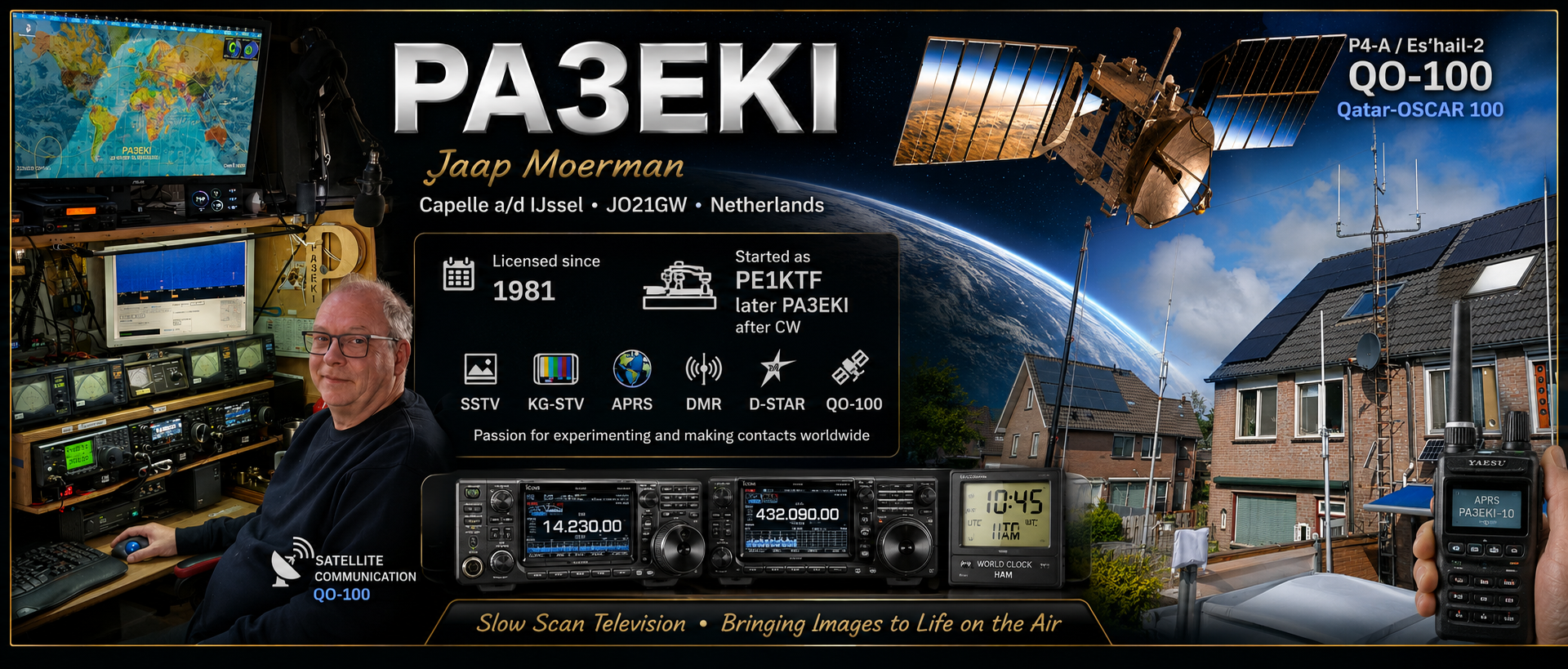
More than 40 years of SSTV with Jaap – PA3EKI
📻 From PE1KTF to PA3EKI
Jaap Moerman has been a licensed radio amateur since 1981.
He first entered the amateur bands with the callsign PE1KTF. Later, after completing his CW qualification, he received the callsign by which he is known today: PA3EKI.
From his station in Capelle aan den IJssel, the Netherlands, at Maidenhead locator JO21GW, Jaap has explored many different areas of amateur radio.
HF, VHF, UHF, satellite communication, APRS, DMR, D-Star and QO-100 are all part of his station today.
But throughout much of his amateur-radio life there has been one mode that has remained particularly special:
Slow Scan Television.
📺 The moment SSTV came to life
Jaap's fascination with SSTV began during his first JOTA in 1985.
Radio amateur Jan PA0IJH was receiving SSTV pictures on 20 metres using an old radar tube.
Jaap watched as the images slowly appeared on the screen. He was immediately fascinated.
Until then radio had meant hearing voices, signals and Morse code coming through the receiver. SSTV added something completely different.
Suddenly an image could travel through the air and slowly become visible on a screen.
That first experience during JOTA would become the beginning of a fascination with SSTV that has continued for more than four decades.
🔧 Building the first SSTV station
After seeing SSTV for the first time, Jaap wanted to receive pictures at his own station.
He obtained an SSTV receiver using a radar tube and connected it to an Eddystone valve receiver.
The Eddystone was chosen because of its excellent receiving performance and became an important part of Jaap's early SSTV setup.
Receiving pictures was only the beginning. Jaap also wanted to transmit them.
His first SSTV transmitter was therefore a home-built SSTV coder.
It could transmit only one SSTV mode and was connected to a Kenwood TS-530S all-band HF transceiver.
Sunday afternoons on 20 metres soon became regular SSTV operating time.
At that time many of the pictures Jaap received came from Italian SSTV stations, making 20 metres a lively meeting place for image transmission.
🖥️ From radar tube to digital pictures
As SSTV technology developed, Jaap's station developed along with it.
The radar-tube equipment was eventually replaced by a digital SSTV coder and decoder built and sold by a fellow radio amateur in Zoetermeer.
Pictures were now displayed on an old monitor, although they were still shown in black and white.
Compared with today's colourful computer screens this may appear primitive, but at the time it represented a major step forward.
Dedicated SSTV hardware was slowly giving way to the computer-based systems that would eventually transform the mode completely.
💻 The arrival of MMSSTV
When MMSSTV became available, Jaap made the transition to computer-based SSTV.
That did not mean everything suddenly became plug-and-play.
Jaap built the interfaces between the computer and radio himself.
The computer's speaker and microphone connections were used for audio, while a serial connection controlled switching between receive and transmit.
It was another example of something that has always been part of amateur radio: experimenting, building something yourself and making different technologies work together.
Over the years Jaap also experimented with other programs, including EasyPal and Black Cat.
Nevertheless, two programs remain his favourites: MMSSTV and KG-STV.
The reason is straightforward. Jaap knows them well, they are stable, and they simply work.
His present station can even operate three instances of MMSSTV simultaneously, together with KG-STV.
⚜️ Amateur radio, SSTV and Scouting
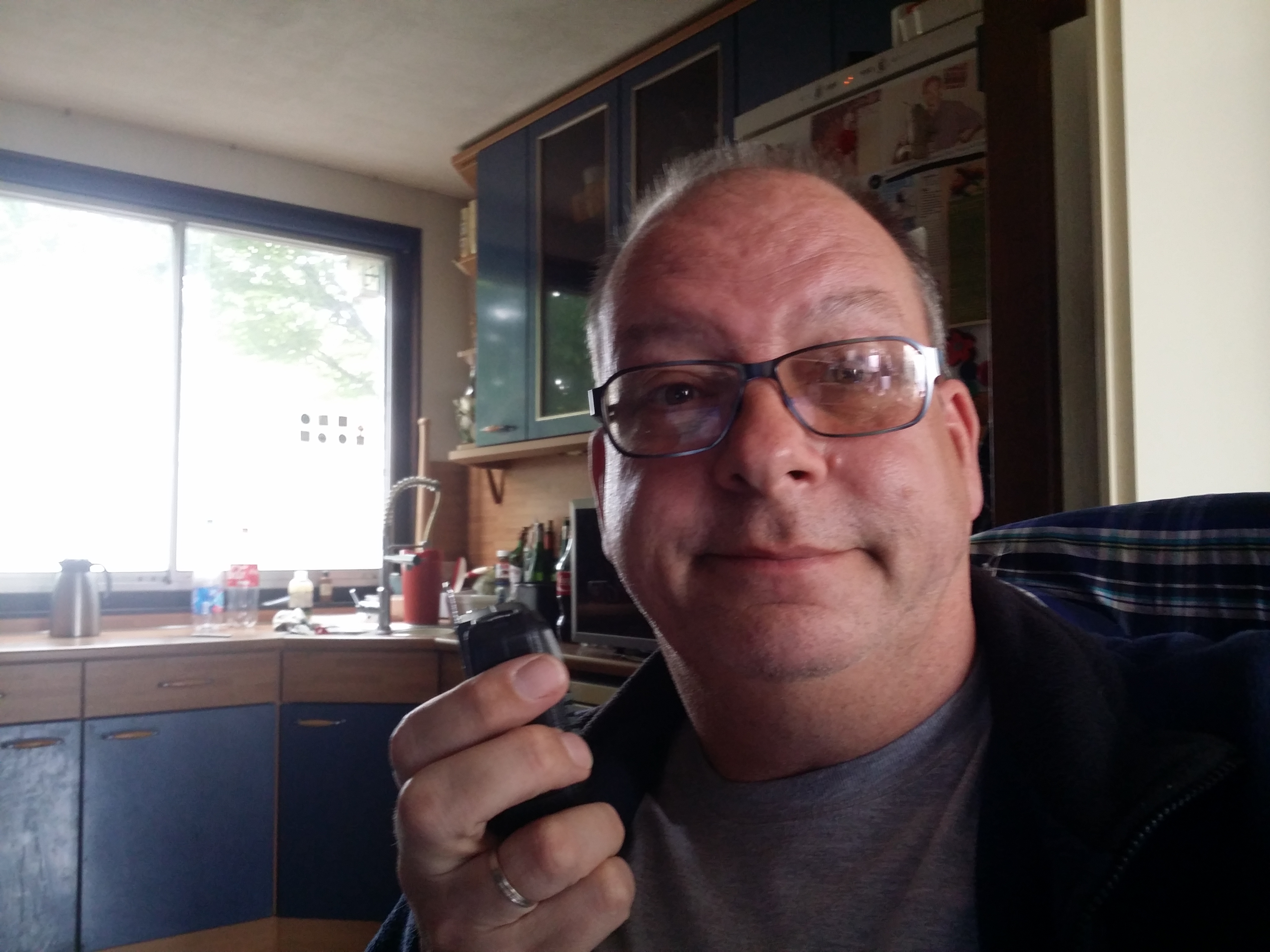
The place where Jaap first discovered SSTV would remain important throughout his radio life: Scouting and JOTA.
During JOTA events and international Scouting camps, including the Haarlem Jamborette, Jaap regularly introduced Scouts to amateur radio.
Alongside normal voice contacts, SSTV provided something particularly attractive for young participants.
Photographs taken at the camp could be transmitted by radio and received by another station, sometimes many thousands of kilometres away.
This made radio communication visible.
Instead of only hearing a distant voice, the Scouts could actually watch an image from their own camp being exchanged through amateur radio.
🌎 A memorable contact with the Andes
Among all those JOTA and Scouting contacts, one SSTV connection remains particularly memorable.
During an international Scouting camp, Jaap made an SSTV contact with a station located in the Andes Mountains.
For the Scouts this was something special.
A picture from their camp in the Netherlands had travelled by radio to a station high in the Andes.
It demonstrated perfectly why amateur radio can capture the imagination of young people.
With a radio, an antenna and some technical curiosity, enormous distances suddenly become much smaller.
🛰️ SSTV via QO-100
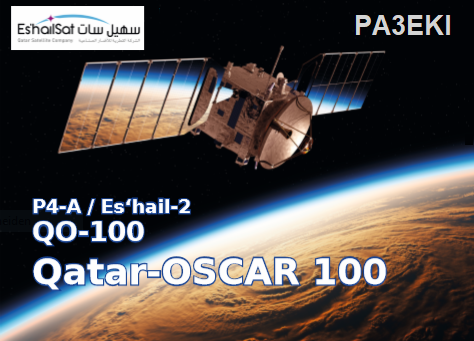
In 2021, another major chapter was added to Jaap's amateur-radio activities when he became active through QO-100.
The geostationary amateur-radio satellite provides coverage across a huge part of the world and opened another completely different way of operating.
Naturally, SSTV soon became one of Jaap's main modes on the satellite as well.
A regular group of amateurs now exchange pictures through QO-100, and many of the callsigns have become familiar over the years.
One of Jaap's regular SSTV friends is Yannick F4CYH, another long-time SSTV operator.
Jaap first encountered Yannick through SSTV on 20 metres.
Years later, the two operators met again on SSTV — this time through a satellite almost 36,000 kilometres above the Earth.
The technology had changed enormously. The familiar callsigns and friendships had not.
🎙️ The PA3EKI station today
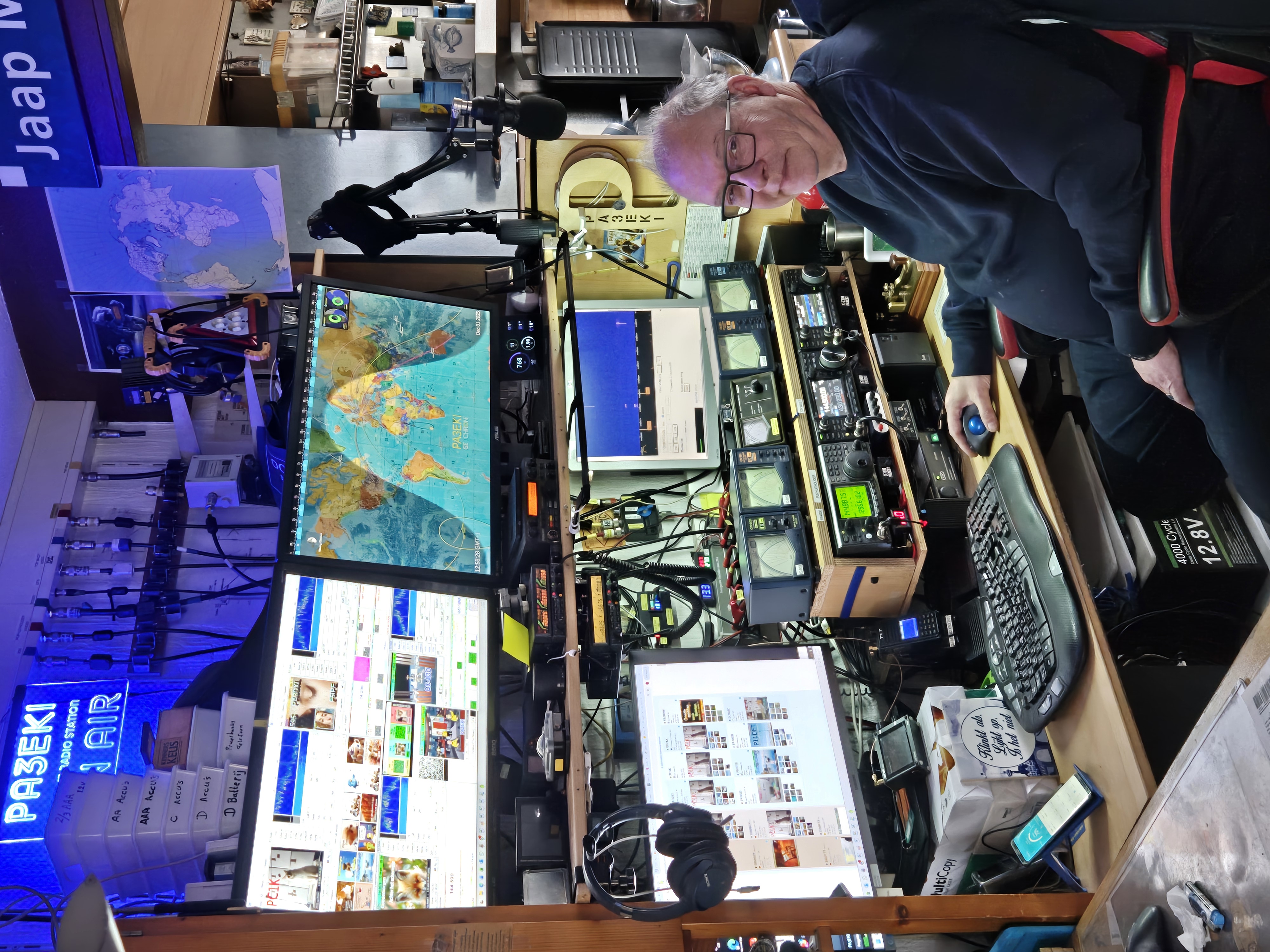
More than forty years after those first SSTV pictures appeared on a radar tube, the PA3EKI station has developed into an extensive multi-band and multi-mode amateur-radio station.
Jaap's equipment includes an Icom IC-7300 for HF, an Icom IC-9700 for VHF/UHF/SHF, and an Icom IC-910 used for satellite communication.
Several Kenwood TM-742 transceivers provide operation on combinations of 6 metres, 2 metres, 70 centimetres and 23 centimetres.
His station also includes APRS, DMR and D-Star facilities, as well as a Geochron World Clock with the amateur-radio package.
📡 Radio equipment
- Icom IC-910 – satellite communication
- Icom IC-7300 – HF
- Icom IC-9700 – VHF/UHF/SHF
- 2 × Kenwood TM-742 – 2m / 70cm / 23cm
- Kenwood TM-742 – 6m / 2m / 70cm
- Yaesu VX-8G – APRS
- TYT MD-380 handheld radios
- Several hotspots for DMR and D-Star
- Geochron World Clock with HAM package
📶 Antennas above Capelle aan den IJssel
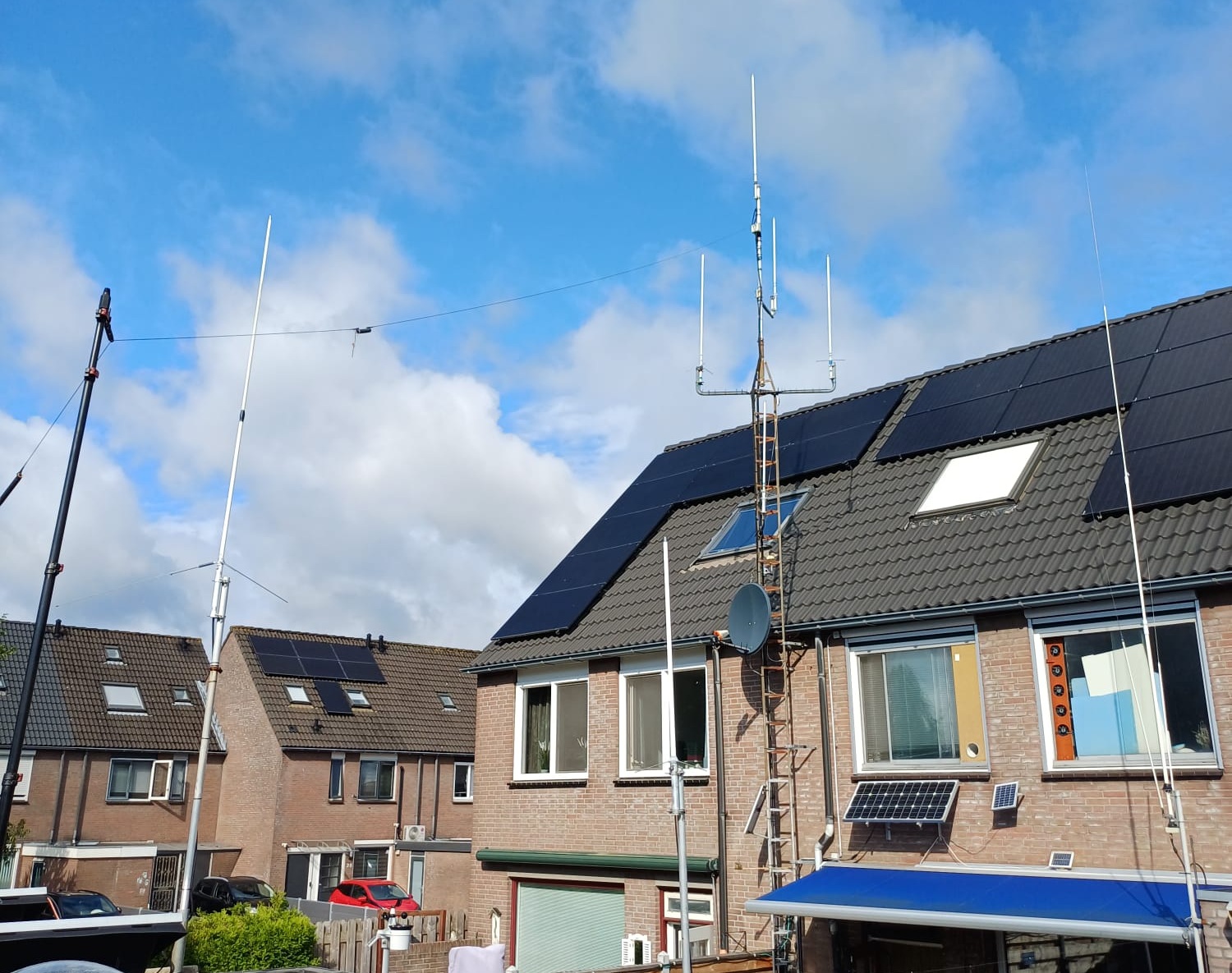
A station covering everything from HF to satellite communication naturally needs a variety of antennas.
Jaap uses a Hy EndFed and Sigma HF360 for HF operation.
His VHF and UHF antenna systems include a Diamond X5000, Diamond VX4000 and Diamond V2000.
A Diamond X50 is used for the PA3EKI-10 APRS gateway on 2 metres.
The QO-100 system adds satellite communication on the 3 centimetre amateur band.
🌍 Bands and modes
PA3EKI is active across a remarkably wide range of amateur-radio bands:
40m • 20m • 17m • 6m • 2m • 70cm • 23cm • 3cm
His main interest remains SSTV and KG-STV, but the station is also active with:
- SSTV
- KG-STV
- APRS
- Satellite communication
- QO-100
- DMR
- D-Star
The APRS gateway operates as PA3EKI-10 on 2 metres.
🤝 Helping others discover SSTV
Jaap's interest in SSTV has never been limited to his own station.
On his personal website he created an SSTV section aimed at radio amateurs who are just starting with the mode.
After more than forty years of SSTV experience, passing that knowledge on to other operators is a natural continuation of the hobby.
📍 PA3EKI station location
Jaap Moerman – PA3EKI
Capelle aan den IJssel
Netherlands
Maidenhead Locator: JO21GW
Latitude:
51.954590° N
Longitude:
4.577402° E
❤️ More than forty years of SSTV
Amateur radio has changed dramatically since Jaap watched those first pictures appear on an old radar tube in 1984.
Valve receivers were replaced by modern transceivers. Dedicated SSTV coders gave way to computers. Black-and-white monitors became high-resolution colour displays.
And a mode once received on 20 metres through an Eddystone receiver can now travel through a geostationary satellite.
Yet the fascination remains the same.
A radio signal carries an image across distance. Somewhere else, another amateur sees that picture appear.
More than forty years after his first encounter with SSTV, Jaap PA3EKI is still exchanging pictures, experimenting with radio and enjoying the mode that first caught his attention during JOTA in 1984.
From a radar tube to QO-100 — the technology changed, but the passion for SSTV remained.
📷 Photo Credits & Copyright
Photographs and station images on this page are provided by Jaap Moerman – PA3EKI and are used with permission.