Voice communication
Talk to radio amateurs locally, across Europe or on the other side of the world.
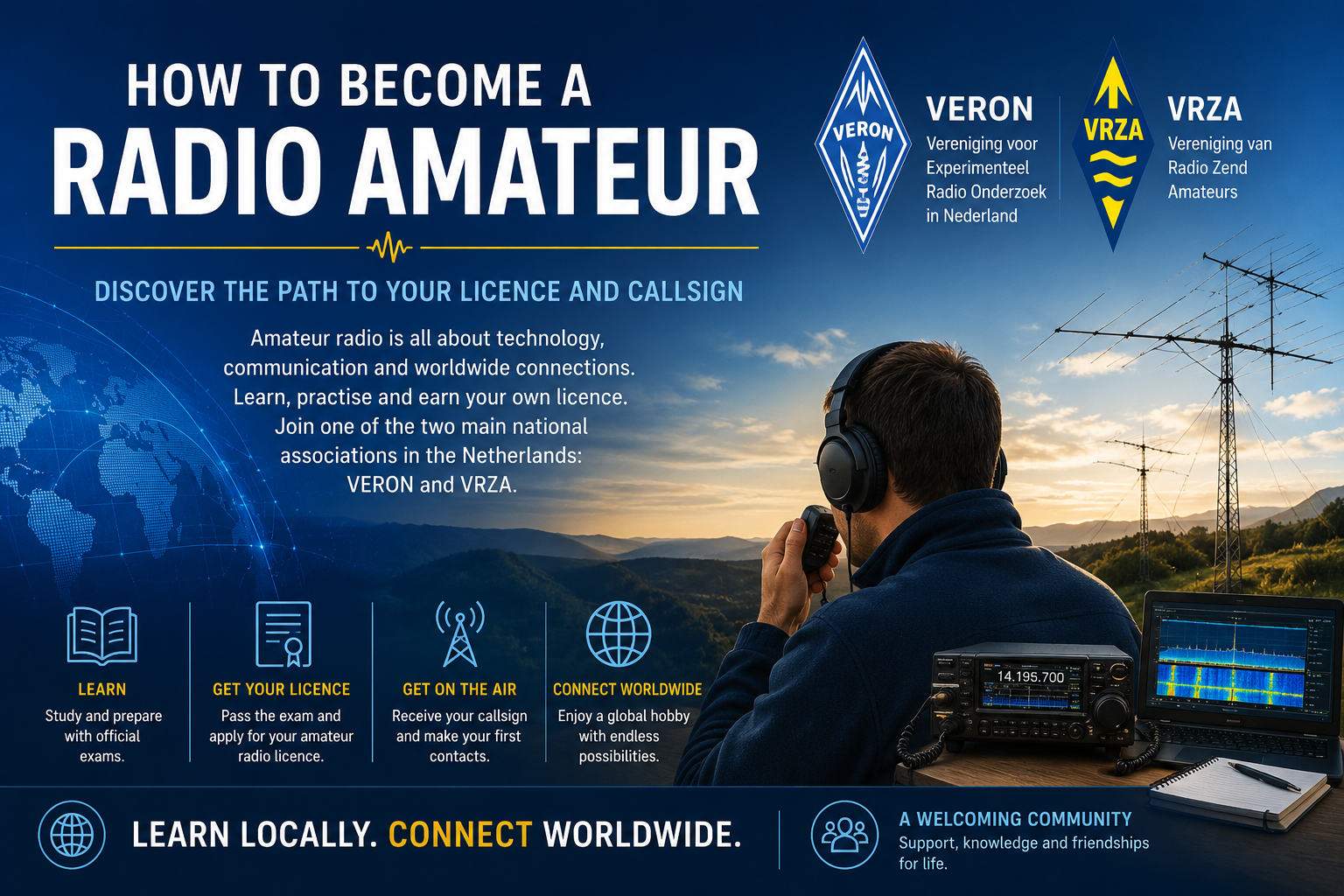
Amateur radio is a worldwide technical and social hobby that brings together communication, electronics, antennas, computers, satellites, image transmission and experimentation.
You can begin as a listener without a transmitting registration. To transmit on amateur radio frequencies in the Netherlands, you must pass a Novice or Full examination and then register with the Rijksinspectie Digitale Infrastructuur.
Amateur radio is a licensed radio service for personal communication, technical investigation, self-training and experimentation.
Radio amateurs use allocated frequency bands to communicate locally and internationally. They may use speech, Morse code, pictures, data, television, satellites and many specialised digital modes.
Curiosity and a willingness to learn are more important. Many radio clubs and experienced operators are happy to help beginners take their first steps.
Amateur radio contains many different activities. You can specialise in one subject or continue discovering new parts of the hobby for many years.
Talk to radio amateurs locally, across Europe or on the other side of the world.
Receive and transmit pictures using Slow Scan Television on HF, VHF and satellites.
Experiment with FT8, RTTY, PSK, JS8Call, packet radio and many other digital modes.
Receive satellites, contact other stations through amateur satellites and follow ISS SSTV events.
Experiment with analog ATV and modern digital amateur television on the higher radio bands.
Construct antennas, interfaces, receivers, transmitters and other electronic projects.
Take your station outdoors for field days, islands, parks, summits and emergency exercises.
Participate in friendly radio competitions and collect contacts, countries and operating awards.
The Netherlands has two examination levels. Both allow you to become a registered radio amateur, but the technical depth and operating privileges differ.
The Novice examination is designed as an accessible way to enter amateur radio. It covers essential radio theory, operating practice, safety and regulations.
The Full examination contains more extensive technical material and gives access to broader operating privileges after registration.
Novice is a good starting point if radio technology is new to you. You may also study directly for Full when you already have technical knowledge or want the broadest possibilities. You are not required to obtain Novice before taking Full.
Start by listening, visiting a local radio club and discovering which parts of amateur radio interest you most.
Choose the Novice examination as an accessible starting point, or study directly for the more extensive Full examination.
Learn radio technology, operating procedures, safety, interference prevention, antennas and national regulations.
Book the digital Radio Amateur Novice or Full theory examination through the CBR.
After passing the examination, register as a radio amateur with the Rijksinspectie Digitale Infrastructuur.
Select an available Dutch callsign and begin operating within the permissions of your registration.
The exact depth depends on whether you choose Novice or Full, but your study generally includes the following subjects.
Study at your own pace with online course material, technical explanations and practice questions.
Some VERON and VRZA departments organise courses with experienced amateur radio instructors.
Use practice questions to become familiar with the examination style and discover subjects requiring additional study.
A first station does not need to be large or expensive. Start simply, gain experience and expand your equipment as your interests develop.
A radio suitable for the bands and modes you want to use.
A suitable antenna is often more important than an expensive radio.
Most fixed amateur radio transceivers require a stable 13.8-volt power supply.
Use suitable low-loss coaxial cable and correctly fitted connectors.
Useful for SSTV, FT8, logging, radio control and other digital modes.
Check that the antenna is correctly adjusted before transmitting.
Everyone may listen to amateur radio transmissions, but transmitting requires a valid registration and callsign. Always operate within the frequency, mode and power limits that apply to your registration.
The Dutch authority responsible for radio amateur registration, callsigns and frequency regulations.
Radio amateur information ↗The organisation that administers the digital Novice and Full theory examinations in the Netherlands.
Examination information ↗A national amateur radio association with local departments, courses, activities and technical support.
Visit VERON ↗A national radio amateur association offering activities and freely accessible Novice and Full study material.
Visit VRZA ↗