P5
Perfect
The image is completely clear and correctly decoded. Colours, details and text are clearly visible.
- No visible noise
- No interference
- No slant or synchronisation problems
- Good colour and contrast
- All text is readable
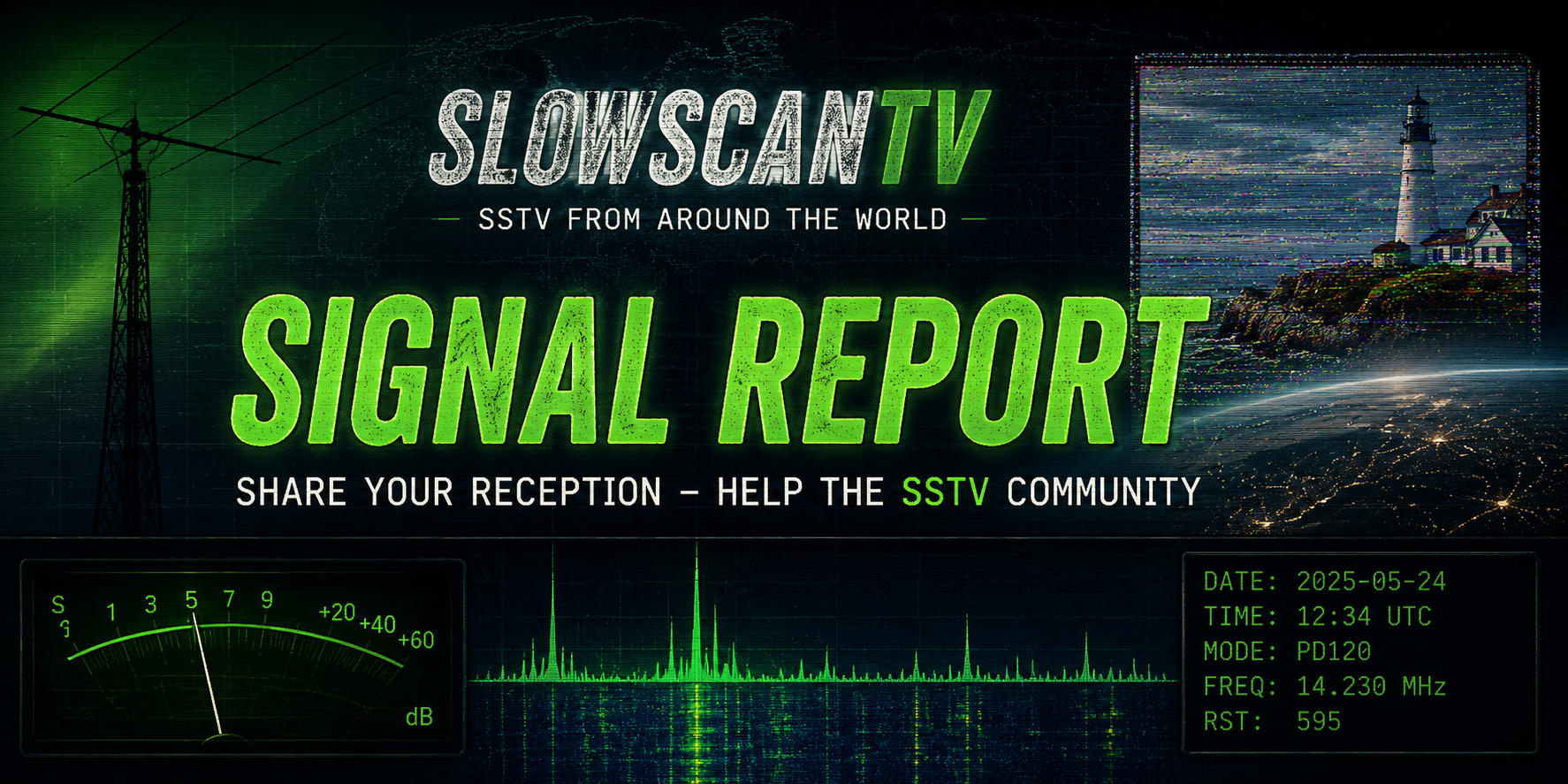
Signal reports are an important part of amateur-radio communication. They tell the transmitting station how well its signal and image were received.
SSTV operators can use the P System to report picture quality, or the more complete RSV System to describe readability, signal strength and video quality.
A signal report is more than a friendly number exchanged during a contact. It provides useful technical information about how the transmission arrived at the receiving station.
An accurate SSTV report can help an operator evaluate radio conditions, transmitted audio, tuning, antenna performance, signal strength and final picture quality.
Reports are especially useful when testing new equipment, adjusting audio levels, comparing antennas or investigating interference and propagation conditions.
The SSTV P System describes the visible quality of a received picture. The letter P stands for Picture.
Picture quality is reported on a five-point scale. A report of P5 describes a perfect or nearly perfect image, while P1 means that the image is only barely visible.
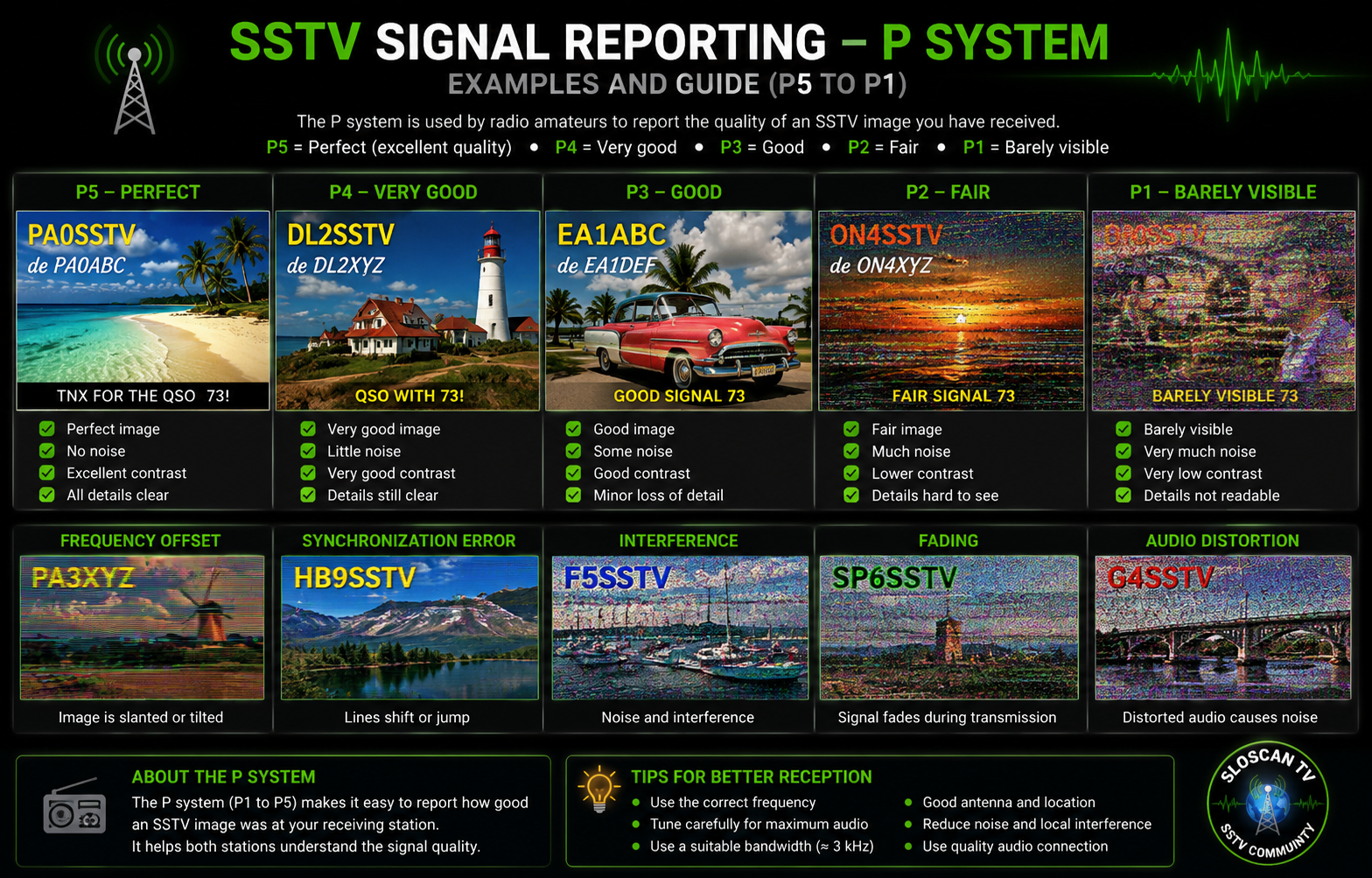
The image is completely clear and correctly decoded. Colours, details and text are clearly visible.
The image is clear and easy to recognise, but contains slight noise or a small imperfection.
The image contains noticeable noise or distortion but remains clearly recognisable and useful.
Heavy noise, fading or distortion has damaged a considerable part of the picture.
Only a small part of the image is visible. The picture is difficult to identify because of severe reception problems.
The P-signal reporting system was developed by Larry Peterson, WA9TT, as a way to provide SSTV operators with a more useful description of received picture quality.
A traditional report such as 595 may be perfectly understandable to an experienced radio amateur, but it was never designed specifically to describe an SSTV image. Two pictures received under very different conditions can therefore end up with similar conventional reports, even though their visible quality is clearly different.
The P-system approaches the report from the picture itself. Instead of concentrating only on signal strength and readability, the operator considers how well the SSTV image was actually received.
This is why the P1–P5 scale is so useful: it gives both stations a quick indication of the visible result. P5 represents an excellent or virtually perfect picture, while the lower P values indicate increasing degradation until the image is only barely usable.
Developing the system was not simply a matter of choosing five labels. Larry used statistical analysis and numerous on-air experiments to test whether the reporting method corresponded with what operators were actually seeing on their screens.
His work was published in the January 2017 issue of CQ Magazine and the P-signal reporting system was later included in the ARRL Handbook.
Today the system is increasingly used by SSTV operators, particularly in North America, because it gives the transmitting station something much more useful than a number alone: an indication of how the transmitted picture actually arrived.
You can also read the personal story behind this work in our Ham Radio Heritage section: Larry Peterson, WA9TT – A Lifetime in Amateur Radio →
The purpose of the reporting system is to provide useful feedback. Giving every received image a P5 report makes the report less meaningful.
A truthful P3 or P4 report is often more useful than an automatic P5. It tells the transmitting operator that the picture was received, while also indicating that noise, fading or another problem was visible.
An accurate report is not unfriendly or negative. It helps operators assess their station and understand the conditions during the contact.
A P5 report should be reserved for a genuinely excellent picture. A received image with visible noise is usually better described as P4, P3 or lower.
A complete SSTV signal report is often written as three numbers using the letters RSV:
Describes how easily the transmitted audio, callsign or accompanying voice communication can be understood.
Scale: 1 to 5
Describes the strength of the received radio signal, traditionally using the receiver's signal meter or an operator estimate.
Scale: 1 to 9
Describes the visible quality of the decoded SSTV image. This is comparable to the P1-to-P5 picture scale.
Scale: 1 to 5
The first number, 5, means that the transmission is perfectly readable.
The second number, 9, means that the received radio signal is extremely strong.
The third number, 5, means that the received SSTV picture is perfect.
A report of 595 should therefore describe an exceptionally good reception. It should not automatically be used for every successfully decoded picture.
Perfectly readable, extremely strong signal and a perfect SSTV picture without visible noise or distortion.
Perfect readability and very strong signal, but the image contains slight noise, fading or another small defect.
Perfect readability and a strong radio signal, while the decoded image contains clearly visible noise or fading.
Readable with little difficulty, moderately strong signal and a heavily damaged but still recognisable image.
The picture report should reflect everything visible in the final decoded image. Several different reception problems can reduce the P or V value.
A weak signal may produce grainy noise, coloured dots, missing lines and sections that cannot be decoded.
Changing HF signal strength can create horizontal bands, colour changes or damaged areas across the picture.
Incorrect SSB tuning can cause a slanted image, colour errors or failure to recognise the transmitted mode.
Power supplies, computers, LED lighting and other electronics can produce interference visible in the image.
Audio that is overdriven, clipped or too loud may damage synchronisation and colour information.
Overlapping transmissions and nearby signals may create lines, patterns or missing picture information.
Missing or damaged synchronisation pulses can cause image tearing, shifted lines or incorrectly positioned sections.
A small timing difference between systems can cause the complete picture to lean sideways.
Selecting the wrong mode manually can produce incorrect colours, dimensions or an unreadable image.
Yes. Radio signal strength and decoded picture quality are related, but they are not the same measurement.
A station can arrive with a very strong S9 signal while producing only a P2 or P3 picture because of distorted audio, incorrect tuning, local interference or excessive transmitter deviation.
The opposite is also possible. A moderately strong but clean signal may produce a very good P4 or P5 picture.
This is why an RSV report contains separate values for signal strength and video quality.
A report can be included in a transmitted SSTV image, spoken by voice or sent through another agreed communication method.
Use a P report when you only want to describe the quality of the decoded image.
TNX FOR THE SSTV IMAGE
YOUR PICTURE REPORT IS P4
SLIGHT NOISE
73
Use an RSV report when readability, signal strength and image quality are all being reported.
TNX FOR THE SSTV QSO
YOUR REPORT IS 584
GOOD SIGNAL – SLIGHT NOISE
73
A picture with visible noise, fading or distortion should normally not receive the maximum P5 rating.
A 595 report means that readability, strength and picture quality were all at their maximum value.
An S9 signal does not automatically mean that the received image deserves a P5 or V5 report.
Slant, incorrect colour, missing lines and synchronisation errors should be considered when selecting a picture report.
A lower but accurate report is not an insult. It is useful technical feedback for the other operator.
RST uses the final digit for CW tone. SSTV reporting uses the final RSV digit for video or picture quality.
Correct SSB tuning is essential. Even a small tuning error can change audio frequencies and distort the image.
Audio should be strong enough for reliable decoding but should never be clipped or distorted.
A suitable antenna with a low-noise feed line can increase signal strength and reduce decoding errors.
Identify and remove interference from chargers, power supplies, lighting and network equipment.
Allow the software to detect the SSTV mode or select the correct mode when automatic detection fails.
Recording the complete transmission allows the image to be decoded again with different settings later.
P5 means that the received SSTV image is perfect or extremely close to perfect. It should have no significant noise, interference, slant or missing picture information.
No. P3 means that the picture was successfully received and remains clearly recognisable, although noticeable noise or distortion is present.
A truthful P3 report is useful feedback and is better than an inaccurate P5 report.
P5 reports only the quality of the SSTV picture. A 595 report is a complete RSV report: readability 5, signal strength 9 and video quality 5.
Yes. A strong radio signal can still produce a poor picture because of incorrect tuning, distorted audio, interference, excessive deviation or synchronisation problems.
No. Successfully decoding an image does not automatically mean that the image is perfect. The report should reflect the amount of noise, distortion and lost detail visible in the final picture.
Yes. A standalone P report is useful when you only want to describe picture quality. Use RSV when you also want to report readability and signal strength.
Usually not. The receiving operator examines the decoded picture and selects the rating that best describes its visible quality.
Good SSTV operators do not automatically give perfect reports. They give accurate reports.
An honest report helps other operators improve their stations, compare antennas, adjust audio levels and understand current propagation conditions.
The next time you receive an SSTV image, look carefully at the completed picture before sending your report. A genuine P3, P4 or P5 carries far more useful information than an automatic 595.
Have you received an interesting SSTV image or would you like to share a signal report with other radio amateurs and SSTV enthusiasts? Join the official SlowscanTV.com Facebook group.
Share your SSTV images, reception reports, experiences and questions with enthusiasts from around the world.
Join the SlowscanTV Facebook Group →