1
Selecting an Image
The transmitting operator selects a photograph, test pattern, station card or other image using SSTV software.
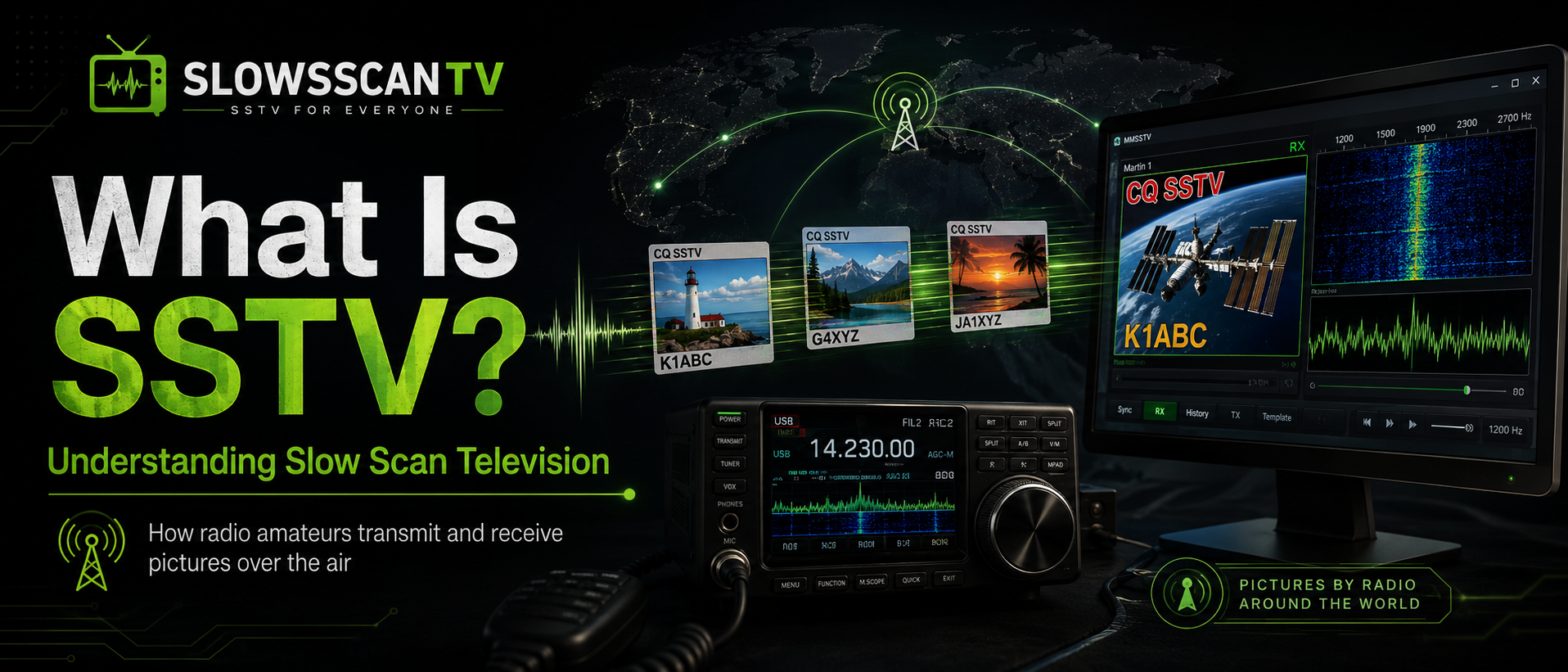
Slow-Scan Television, usually abbreviated as SSTV, is a method used by radio amateurs to transmit and receive still images over radio.
Instead of sending moving video, SSTV converts a picture into a sequence of audio tones. These tones can be transmitted through a normal amateur-radio voice channel and decoded by a computer, smartphone or dedicated SSTV system.
SSTV is a radio communication system that sends one still picture at a time. The image is scanned line by line, converted into audio tones, transmitted over radio and then reconstructed by receiving software.
An SSTV transmission may sound like a series of changing whistles, beeps and tones. Although these sounds may seem unusual to the human ear, SSTV software can interpret them as brightness and colour information.
Depending on the selected SSTV mode, a complete colour image may take approximately 30 seconds to several minutes to transmit.
The transmitting operator selects a photograph, test pattern, station card or other image using SSTV software.
The software scans the image one horizontal line at a time and analyses its brightness and colour information.
The visual information is converted into continuously changing audio frequencies, normally between approximately 1200 and 2300 Hz.
The audio signal is sent through an amateur-radio transmitter using a voice mode such as SSB or FM.
Another station receives the radio transmission and sends the recovered audio into SSTV decoding software.
The receiving software converts the audio tones back into pixels and gradually displays the completed image.
Analogue SSTV does not transmit an image as a computer file. Instead, it represents the picture using a carefully controlled range of audio frequencies.
A frequency near 1200 Hz is commonly used for horizontal synchronisation pulses. These pulses help the decoder determine where each new picture line begins.
Lower image frequencies normally represent darker brightness or colour levels in the transmitted picture.
Higher image frequencies normally represent brighter levels in the picture.
Most analogue SSTV modes are designed to fit inside a standard amateur-radio voice channel.
The actual picture information normally uses audio tones between approximately 1200 and 2300 Hz. A receiver or transceiver filter may be set to around 2.7, 3.0 or 3.2 kHz, depending on the equipment and operating mode.
It is therefore more accurate to say that SSTV needs about 3 kHz of radio bandwidth than to say that every SSTV signal is exactly 3.2 kHz wide.
This narrow bandwidth is one of the reasons SSTV can be used on HF. A still image can travel thousands of kilometres while using approximately the same channel width as a normal voice transmission.
Traditional television transmits many complete images every second, producing moving video. SSTV works much more slowly.
A single SSTV picture is transmitted line by line and can take tens of seconds or several minutes to complete. This slow scanning process allows the image to fit into the limited bandwidth of an amateur-radio voice channel.
An SSTV mode defines how an image is encoded and how long the transmission takes. Each mode has its own resolution, timing, colour system and image quality.
A popular colour mode commonly heard on the HF amateur bands. It offers good image quality and is widely supported by SSTV software.
Another popular colour mode used by radio amateurs around the world, especially for HF SSTV contacts.
A faster colour mode often used for VHF communication and SSTV transmissions from the International Space Station.
A higher-quality colour mode used during many ARISS SSTV events from the International Space Station.
Explore the differences between Martin, Scottie, Robot, PD and other popular SSTV transmission formats.
Radio amateurs use HF propagation to exchange SSTV images over hundreds or thousands of kilometres.
SSTV can be transmitted locally using FM on the 2-metre amateur band, repeaters or direct simplex contacts.
During special events, the ISS transmits commemorative SSTV images that can be received by stations on Earth.
SSTV is used to demonstrate radio propagation, audio modulation, image encoding and space communication.
Operators can receive and send images from portable stations using radios, laptops, tablets or smartphones.
Many operators transmit personalised images containing their callsign, location, equipment and station details.
On HF, SSTV is normally transmitted using single-sideband voice operation. Ionospheric propagation can carry the signal between countries and continents.
On VHF, SSTV is often sent using FM. Reception is normally clearer than HF, but the range is usually limited by terrain, antenna height and repeaters.
The International Space Station occasionally transmits SSTV images on the amateur-radio downlink frequency of 145.800 MHz FM.
Read our complete introduction to receiving SSTV transmissions from the International Space Station.
Receiving SSTV can be surprisingly simple. You do not always need an expensive amateur-radio station to decode your first image.
You need a receiver that can tune to an SSTV frequency and provide clear audio. This may be an amateur transceiver, scanner, shortwave receiver or software-defined radio.
The antenna must be suitable for the frequency being received. Better antennas usually improve signal strength and image quality.
SSTV decoding software runs on computers, smartphones, tablets and some dedicated radio systems.
Radio audio must reach the decoding device. This can be done through an audio cable, USB sound interface or simply by placing a smartphone near the radio speaker.
To receive your first SSTV picture, try holding a smartphone running an SSTV decoder near the speaker of a radio. A direct audio connection usually gives better results, but acoustic decoding is an easy way to start.
One of the best-known SSTV programs for transmitting and receiving analogue SSTV images.
A simple receiving program that automatically detects and decodes many common SSTV modes.
A feature-rich application for receiving and transmitting analogue and digital SSTV.
A popular mobile application that can decode SSTV audio using the smartphone microphone.
In many countries, anyone may receive amateur-radio SSTV transmissions using suitable receiving equipment.
Receiving is an excellent way to explore SSTV before obtaining an amateur-radio licence.
Transmitting on amateur-radio frequencies normally requires a valid amateur-radio licence and an authorised callsign.
Operators must follow their national licence conditions, band plans, power limits and identification requirements.
SSTV pictures are transmitted as live audio. Any disturbance to that audio can become visible in the decoded image.
Electrical noise and weak signals may create coloured dots, lines or missing sections.
HF signals can change strength during transmission, producing horizontal bands or altered colours.
If an SSB receiver is not tuned correctly, the audio pitch shifts and the image may become slanted or incorrectly coloured.
Audio that is too loud, too quiet or distorted can reduce decoding accuracy.
Other stations, local electronics and nearby signals may appear as patterns or disruptions in the picture.
Small timing differences between the transmitter and receiver can cause an image to lean sideways.
SSTV images can be received from other continents using ordinary HF amateur-radio propagation.
The ISS has transmitted many series of commemorative SSTV images for radio listeners around the world.
A smartphone microphone can sometimes decode SSTV directly from a radio speaker.
SSTV signals are often recorded as ordinary audio and decoded again later.
Different SSTV modes provide different balances between transmission speed, resolution and image quality.
You can receive SSTV without transmitting, making it accessible to shortwave listeners and beginners.
Traditional SSTV modes such as Martin, Scottie and Robot are analogue image modes. The picture is represented by continuously changing audio frequencies.
Digital image systems also exist, but they work differently and should not be confused with classic analogue SSTV.
SSTV is a television system in the sense that it sends visual information, but it normally transmits still pictures rather than moving video.
It sounds like a sequence of beeps, whistles and continuously changing tones. The sound changes as each line of the picture is transmitted.
Analogue SSTV is designed to fit inside a standard voice channel of about 3 kHz. The image tones normally occupy approximately 1200 to 2300 Hz in the recovered audio.
A receiver filter may be set to around 2.7, 3.0 or 3.2 kHz depending on the radio and operating mode.
A licence is normally not required simply to receive SSTV. A valid licence is generally required to transmit on amateur-radio frequencies.
Regulations vary by country, so always check the rules that apply in your location.
Yes. Smartphone applications can decode SSTV using the built-in microphone or an audio connection from a receiver.
Yes. Because an SSTV transmission is an audio signal, it can be recorded as a WAV file or another high-quality audio format and decoded later.
Yes. During special ARISS events, the International Space Station transmits commemorative images over amateur radio.
These transmissions are not continuous and only take place during announced events.
Learn what equipment and software you need to receive your first SSTV image.
Discover the common HF, VHF and space frequencies used for SSTV activity.
Compare Martin, Scottie, Robot, PD and other analogue SSTV modes.
Learn how to receive Slow-Scan Television images from the International Space Station.