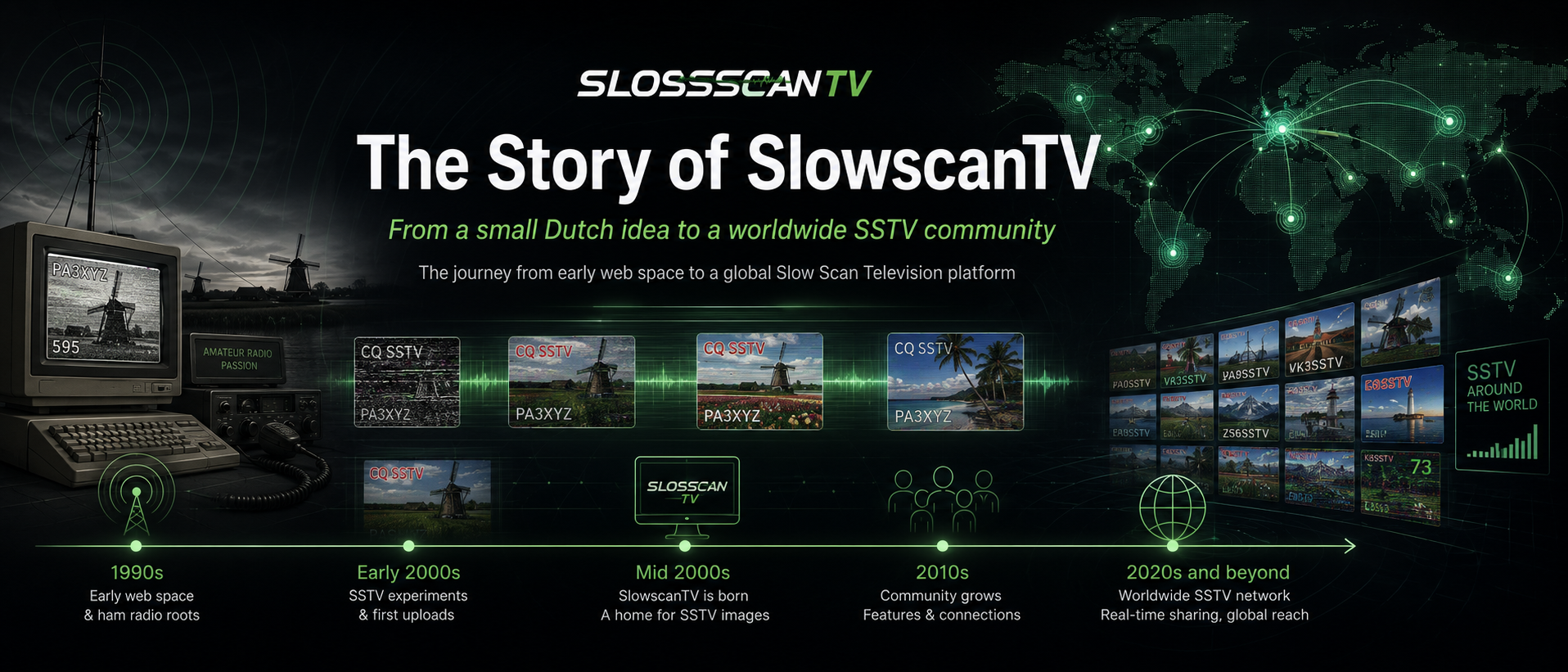
How it started
My interest in Slow Scan Television started many years ago when I met an older radio enthusiast who lived in a nearby village. Because of his disability, radio and SSTV were an important part of his life.
At that time, SSTV was also widely used on the 27 MHz band. I often helped him with his computer and technical problems. I was always welcome at his home, and we spent many enjoyable hours working with computers, radio equipment and received images.
He has sadly passed away, but the interest in SSTV that started during that time has always remained.
The end of the free Ziggo web space
In those early years, several SSTV operators published their received images using free web space provided by Ziggo, a Dutch television and internet provider.
When Ziggo decided to discontinue the free web space, the group did not know what to do. The pages containing their received SSTV images would disappear.
“I know how to build a website. If we share the hosting costs, we can keep the project online and all enjoy it together.”
That idea became the beginning of SlowscanTV.
The first participants
Several radio amateurs helped support the project during its early years. Among them were:
Every February, the participating members received a payment request for their contribution towards a new year of hosting. By sharing the costs, everyone could continue publishing and sharing their SSTV images.
The first HTML website
Willem, PE1PZD, helped me create the first HTML page. It was a simple website, but it provided the foundation for everything that followed.
Later, I learned how to build websites using Joomla. I also completed courses in HTML and CSS, which made it possible to improve and expand the website.
Automatically refreshing the images
One of the biggest technical challenges was finding a way to refresh the received SSTV images automatically.
For years, I searched for a suitable solution. Eventually, another webmaster from the Joomla group in Heerenveen helped find a script that could refresh the images. Every image needed its own unique ID for the system to work correctly.
That version of the website remained operational for almost six years.
A new dynamic website
Internet technology has changed considerably over the years. The original static and Joomla-based website has now been replaced by a new dynamic SlowscanTV platform.
The new website uses PHP, JSON, automatic FTP uploads and personal station archives. Members can have their own station pages, band selections, statistics and collections of recently received images.
Although the technology has changed, the original idea remains the same:
Created by radio enthusiasts, for radio enthusiasts
SlowscanTV exists so SSTV operators can share their received images, help one another and keep this unique part of radio communication alive.
Continuing the story
SlowscanTV started because a small group of radio enthusiasts did not want their SSTV pages to disappear when the free Ziggo hosting ended.
What began as a shared solution has grown into a platform that can welcome SSTV receiving stations from around the world.
This story is still being written.